Sep. 7, 2019

Today, Wikipedia was hit with a malicious attack that has taken it offline in several countries for intermittent periods. The attack is ongoing and our Site Reliability Engineering team is working hard to stop it and restore access to the site.
As one of the world’s most popular sites, Wikipedia sometimes attracts “bad faith” actors. Along with the rest of the web, we operate in an increasingly sophisticated and complex environment where threats are continuously evolving. Because of this, the Wikimedia communities and Wikimedia Foundation have created dedicated systems and staff to regularly monitor and address risks.
Apr. 26, 2018

European law enforcement are today celebrating the dismantling of a website police claim sold Distributed Denial of Service (DDoS) attacks and helped launch up to 6 million of them for as many as 136,000 registered users. Four alleged administrators of the webstresser.org service were arrested on Tuesday in the U.K., Canada, Croatia and Serbia, whilst the site was shut down and its infrastructure seized in Germany and the U.S., Europol announced Wednesday.
Mar. 8, 2018

Memcached DDoS attacks made the headlines due to the magnitude observed in recent offensives. While two PoC exploits for Memcached DDoS attacks have been released online, experts at security firm Corero Network announced they have discovered a ‘kill switch’ to address the Memcached vulnerability.
Source: securityaffairs.co
Mar. 3, 2018

Security researchers at Akamai, the Internet performance company that helped Github fight off the attack, told Fortune they’ve noticed something novel some of these recent attacks. Hackers have started stuffing the barrage of Internet traffic with ransom notes.
Source: fortune.com
Mar. 3, 2018
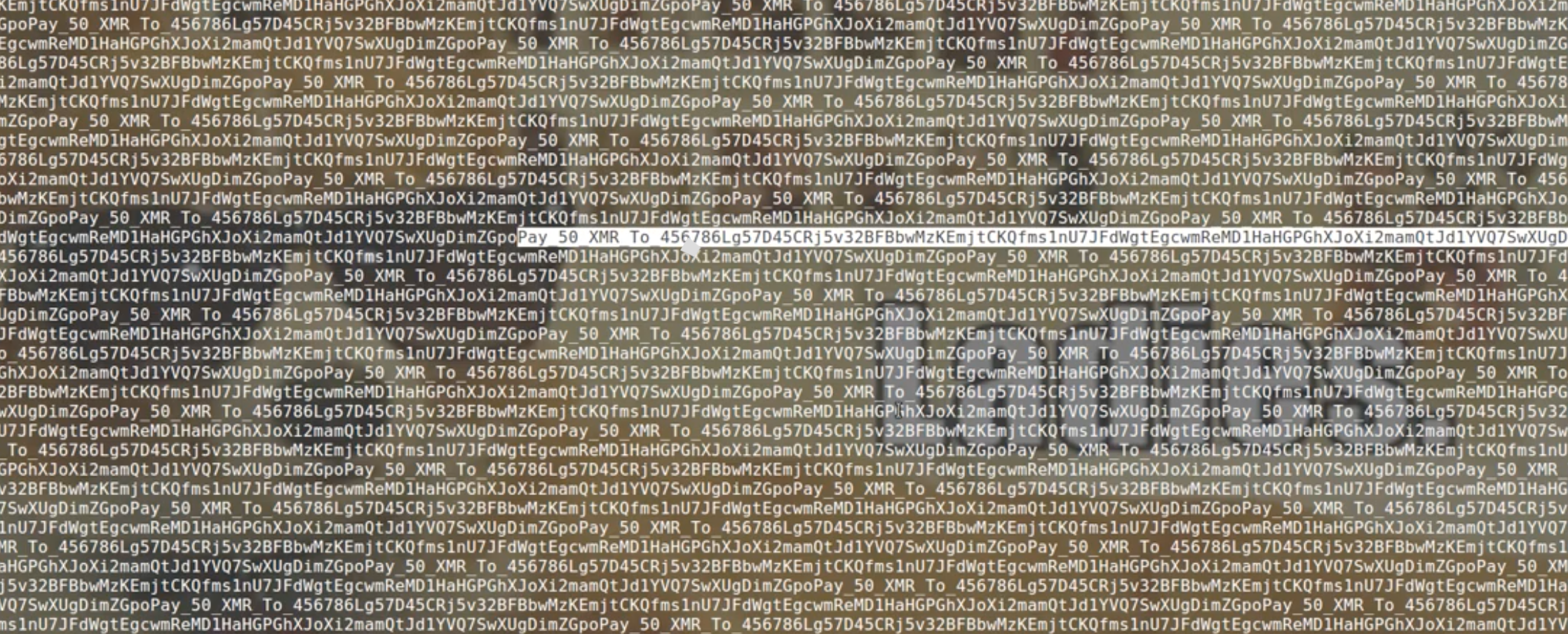
Attackers have seized on a relatively new method for executing distributed denial-of-service (DDoS) attacks of unprecedented disruptive power, using it to launch record-breaking DDoS assaults over the past week. Now evidence suggests this novel attack method is fueling digital shakedowns in which victims are asked to pay a ransom to call off crippling cyberattacks.
Source: krebsonsecurity.com
Mar. 2, 2018

Over last couple of days we’ve seen a big increase in an obscure amplification attack vector – using the memcached protocol, coming from UDP port 11211. In the past, we have talked a lot about amplification attacks happening on the internet.
Source: cloudflare.com
Mar. 2, 2018
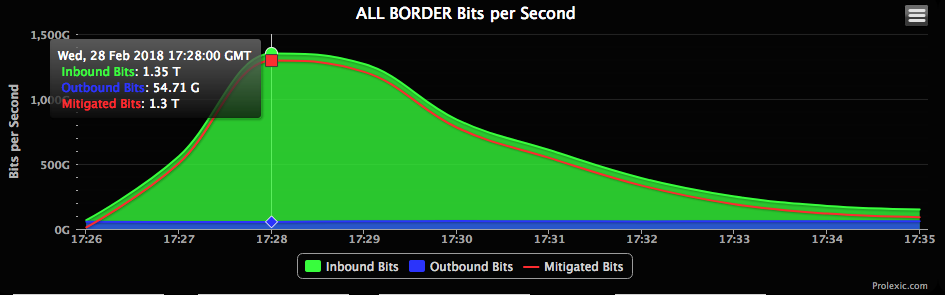
At 17:28 GMT, February 28th, Akamai experienced a 1.3 Tbps DDoS attack against one of our customers, a software development company, driven by memcached reflection. This attack was the largest attack seen to date by Akamai, more than twice the size of the September, 2016 attacks that announced the Mirai botnet and possibly the largest DDoS attack publicly disclosed. Because of memcached reflection capabilities, it is highly likely that this record attack will not be the biggest for long.
Mar. 2, 2018

On Wednesday, at about 12:15 pm ET, 1.35 terabits per second of traffic hit the developer platform GitHub all at once. It was the most powerful distributed denial of service attack recorded to date—and it used an increasingly popular DDoS method, no botnet required.
Source: wired.com
Mar. 2, 2018

On Wednesday, February 28, 2018 GitHub.com was unavailable from 17:21 to 17:26 UTC and intermittently unavailable from 17:26 to 17:30 UTC due to a distributed denial-of-service (DDoS) attack. We understand how much you rely on GitHub and we know the availability of our service is of critical importance to our users. To note, at no point was the confidentiality or integrity of your data at risk.