Dec. 8, 2018

Transaction privacy is a fundamental requirement for many kinds of financial services, and the inability to provide this privacy has prevented Ethereum from providing compelling alternatives to traditional financial instruments. There are several blockchains and blockchain projects that use cryptographic techniques to provide this privacy, but this privacy is reserved for the ‘native’ cryptocurrency of the blockchain in question. This transaction privacy is not accessible for digital assets built on top of blockchain protocols.
Nov. 10, 2018
The recent low in cryptocurrency morale has given our community a rich opportunity for reflection. The vast majority of us crypto enthusiasts have a genuine heart for marrying technology and social action, and I believe it’s time we reflect on where we wanted to go with digital currencies, honestly take stock of the state of blockchain technology today, and rigorously plan how to improve digital currencies moving forward. I’ve been fortunate enough to sit in on many lectures discussing blockchain technologies and incentive structures in computer science at Stanford University, and it’s led me to the conclusion that crypto incentives have driven a lust for global consensus which obscures the important goals we originally had in mind.
Oct. 31, 2018

What are the flaws inherent in both Proof-of-Work and Proof-of-Stake that make Proof-of-Signature an ideal alternative? A short explanation is given below. How does Bitcoin validate transactions and deter denial of service attacks?
It requires a transaction-requesting entity to perform computational work. Inessence, it makes data creation difficult for users but data verification easy for the network. This system is known as Proof-of-Work, a well-known protocol used throughout much of the cryptocurrency world.
Sep. 17, 2018

EOS has recently been in the news following the revelation that an EOS decentralized application (dApp) could access users’ token wallets without their consent through the use of a backdoor technique. More specifically, this EOS dApp is called Trybe, and describes itself as a ”tokenized knowledge sharing network for the crypto and blockchain community”. Issues first arose when Trybe were set to distribute tokens to user accounts through a token airdrop.
Sep. 17, 2018

Although more casual, less-technical crypto-enthusiasts might not know much on this topic, an essential aspect of any cryptocurrency project is the consensus algorithm that it utilizes. These algorithms accomplish two major objectives. Firstly, it ensures that the next block in a blockchain is the true, master-version of the details.
Secondly, it makes sure that those looking to take advantage of the system and fork the chain are stopped. Either way, the point is that consensus algorithms are the way that cryptocurrencies ensure that their digital tokens aren’t victim to double spending. While essential, there have emerged a wide variety of consensus algorithms amongst the various cryptocurrencies, each with their own pros and cons.
Sep. 9, 2018

Over the last few years, there’s been a lot of projects, both public and private, that are attempting to create a next-generation blockchain or something better than Satoshi’s Bitcoin. A great majority of these projects have condemned proof-of-work (PoW) cryptocurrencies because they think they waste resources, and many of these new blockchains have chosen to use a proof-of-stake (PoS) system. However, PoS has many flaws and introduces a distribution process that advocates an ugly planned economy that’s propagated by ancient thinking and basically the old banking system.
Jun. 6, 2018

Malta, an island nation in the Mediterranean Sea, is completing the first ever attempt by a nation state to tie citizen records to the blockchain. If successful, a scaled-up version of the pilot program will give Malta’s 400,000 residents the ability to retrieve and share educational records and transcripts for free. What’s more, it wouldprovide a proof-of-concept that could inspire other countries to adopt similar programs.
May. 29, 2018
Security researchers have discovered a series of new vulnerabilities in EOS blockchain platform, one of which could allow remote hackers to take complete control over the node servers running the critical blockchain-based applications. EOS is an open source smart contract platform, known as ‘Blockchain 3.0,’ that allows developers to build decentralized applications over blockchain infrastructure, just like Ethereum. Discovered by Chinese security researchers at Qihoo 360—Yuki Chen of Vulcan team and Zhiniang Peng of Core security team—the vulnerability is a buffer out-of-bounds write issue which resides in the function used by nodes server to parse contracts.
May. 25, 2018

This is not about archival nodes. This is about about staying in sync, after the fact. My Argument: Ethereum’s runaway data directory size is just the tip.
My Prediction: It will all work, until it doesn’t. My Suggestion: Transpose. My Argument: Ethereum’s runaway data directory size is just the tip.
My Prediction: It will all work, until it doesn’t. My Suggestion: Transpose. My Argument:
May. 24, 2018
It should be acknowledged that if database coordination and more efficient allocation of code is the desired functionality of a system, then blockchain may not necessarily be the solution for which an organization is looking. Distributed ledger technology (DLT) systems like IBM Fabric or R3 Corda are capable of similar functionalities as blockchain systems, but it should be taken into consideration that blockchains are a separate subset of distributed ledgers that have additional functionality beyond code coordination. Blockchains are capable of functions that distributed ledgers are not in terms of instantiation of digital value based on the composition of the system.
May. 24, 2018

A malicious miner successfully executed a double spend attack on the Bitcoin Gold network last week, making BTG at least the third altcoin to succumb to a network attack during that timespan. Bitcoin Gold director of communications Edward Iskra first warned users about the attack on May 18, explaining that a malicious miner was using the exploit to steal funds from cryptocurrency exchanges. To execute the attack, the miner acquired at least 51 percent of the network’s total hashpower, which provided them with temporary control of the blockchain.
May. 22, 2018

Cryptocurrency enthusiasts are keen on telling ordinary civilians how safe and secure the Blockchain protocols powering their favorite coins are. Indeed, major cryptocurrencies like Bitcoin and Ethereum have maintained their security quite well—better, arguably, than any other digital asset/payment system in history—which is pretty remarkable, considering that they are unbacked digital money free from any single party’s control with an effective multi-billion dollar bounty on their proverbial heads. Last month, an as-of-yet unidentified attacker was able to severally compromise Verge, a relatively small, privacy-focused cryptocurrency.
May. 14, 2018

Here’s what happened: HSBC issued a letter of credit for U.S. food and agriculture firm Cargill to Dutch lender ING. The trade finance transaction involved a shipment of soybeans from Argentina to Malaysia. Using blockchain technology, this letter is stored on an open, distributed ledger where every transaction is visible to anyone with access to the system.
This eliminates the need for paper reconciliation and a long chain of digital (and paper) communication between the two parties. HSBC and ING said the exchange was performed in 24 hours, whereas it normally takes five to 10 days for such a transaction to go through traditional methods. HSBC used the “Corda” platform, which was developed by blockchain company R3.
May. 14, 2018

Ethereum developers have long known that scaling the network is a subject worth discussion and investment. The matter did not quite spill out from the developer community, however, until late 2017, when a decentralized application (dApp) named CryptoKitties attracted so much traffic it began slowing down the network. On top of network latency, the price of gas—the fee required to run each operation within a contract on the Ethereum blockchain—soared as users competed for their transactions to be validated.
May. 12, 2018

Swiss startup Sirin Labs has introduced a smartphone Finney, the software component of which is based on the blockchain technology. From the technical side, Finney is not very different from other models of the higher price segment. Six-inch screen smartphone is characterized by an aspect ratio of 18: 9.
The device is based on the flagman SoC Snapdragon 845, supplemented with 6 GB of RAM and 128 GB of flash memory. The main camera has a resolution of 12 megapixels, and the front camera has an 8-megapixel resolution. The battery capacity is 3000 mAh.
May. 4, 2018

A little over a year ago, the three Lightning Network implementation teams joined forces to work on a common specification for the protocol stack. Now that both that specification and our three implementations are becoming stable and usable, it is time to look forward: to further improve the protocol, to add new features, to simplify, and to fix downsides.
Source: blockstream.com
Apr. 27, 2018

After signing up for an account and putting in payment information, all you have to do is reply to the tweet you want archived with ‘ @totheblockchain.’ The bot will automatically post the tweet to the blockchain and charge you the $9 fee.
Source: vice.com
Apr. 23, 2018

Superposition lets one qubit perform two calculations at once, and if two qubits are linked through a quantum effect known as entanglement, they can help perform 2^2 or four calculations simultaneously; three qubits, 2^3 or eight calculations; and so on. In principle, a quantum computer with 300 qubits could perform more calculations in an instant than there are atoms in the visible universe. A powerful enough quantum computer could successfully break conventional cryptography, including that protecting blockchains.
Apr. 22, 2018
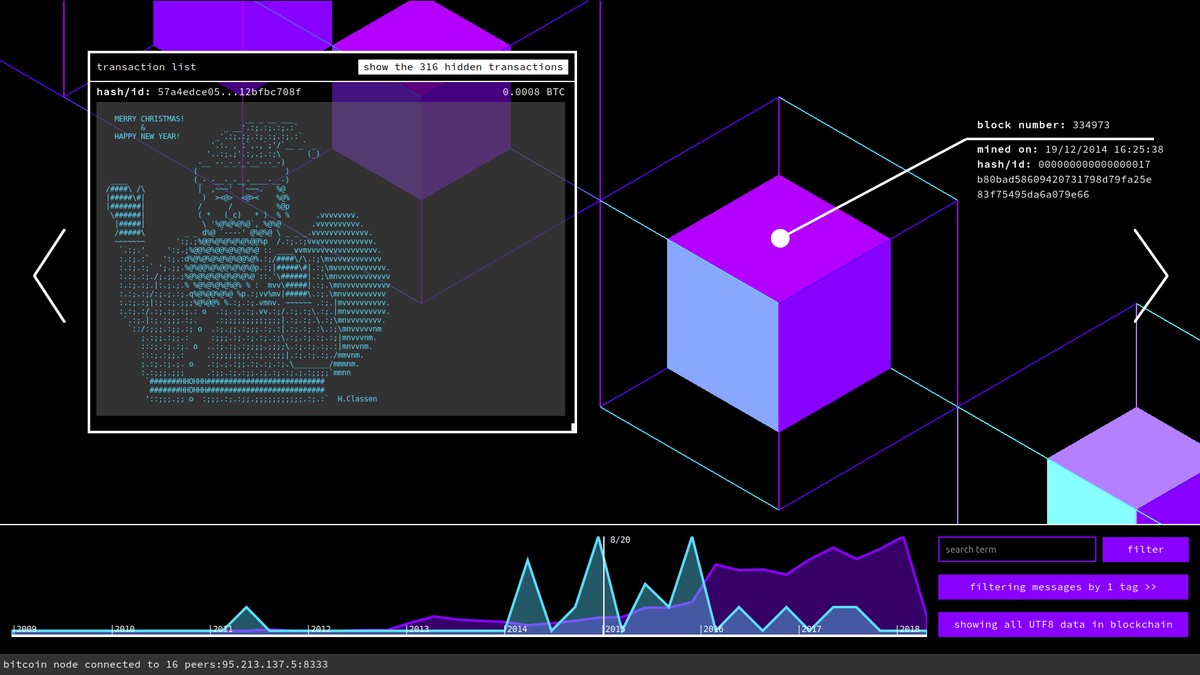
The Bitcoin blockchain now consists of over 500,000 such blocks and a new one is added roughly every ten minutes. Most of these blocks contain data related to sending and receiving Bitcoin, but the blockchain also contains its fair share of short messages—like the one Nakamoto put in the first-ever block of data—photos, and even artworks hidden among the data if you know where to look and how to extract them.
Apr. 18, 2018

This is an explanation of the key function on Proof-of-Work in the Bitcoin blockchain. It focuses on the one feature of Proof-of-Work that is essential and shows that other features often talked about such as security are secondary side-effects, useful, but not essential.
Source: grisha.org