Oct. 5, 2019

Google has announced today new privacy-centered updates for three of its services — namely Google Maps, YouTube, and Google Assistant. More specifically, Google Maps will be getting an incognito mode, YouTube is getting a history auto-delete option, and Google Assistant is getting support for voice commands that will help users manage the Assistant’s own privacy settings. In addition, Google also launched a new Password Checkup feature that checks users’ passwords if they’ve been leaked at other online services.
Oct. 5, 2019

A first-of-its-kind research project highlights the connections between nearly 2,000 samples of Russian APT malware. Russia’s state-sponsored hacking groups rarely share code with one another, and when they do, it’s usually within groups managed by the same intelligence service, a new joint report published today reveals. This report, co-authored by Check Point and Intezer Labs, is a first of its kind in its field.
Oct. 5, 2019

Binary Hardening in IoT products
Source: cyber-itl.org
Oct. 5, 2019

Attackers are exploiting a zero-day vulnerability in Google’s Android mobile operating system that can give them full control of at least 18 different phone models, including four different Pixel models, a member of Google’s Project Zero research group said on Thursday night. There’s evidence the vulnerability is being actively exploited, either by exploit developer NSO Group or one of its customers, Project Zero member Maddie Stone said in a post. NSO representatives, meanwhile, said the ‘exploit has nothing to do with NSO.’
Sep. 14, 2019

France and Germany have agreed to block Facebook’s Libra cryptocurrency, the French finance ministry said on Friday. In a joint statement, the two governments affirmed that “no private entity can claim monetary power, which is inherent to the sovereignty of nations”. French Finance Minister Bruno Le Maire said on Thursday that Facebook’s new cryptocurrency should not be allowed to operate in Europe while concerns persist about sovereignty and persistent financial risks.
Sep. 14, 2019
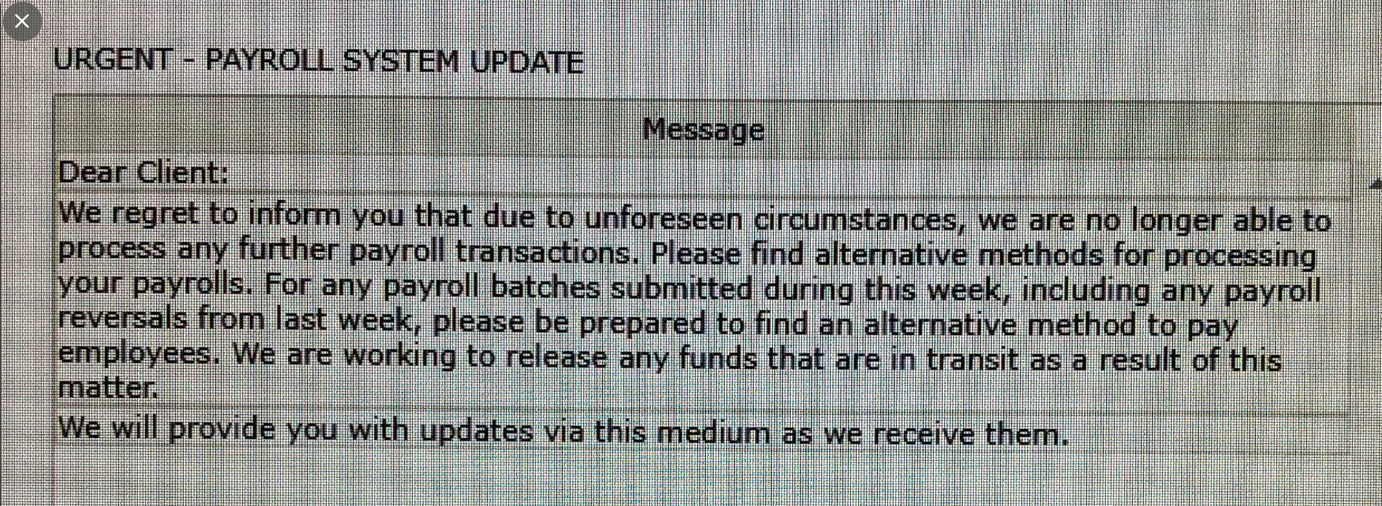
MyPayrollHR, a now defunct cloud-based payroll processing firm based in upstate New York, abruptly ceased operations this past week after stiffing employees at thousands of companies. The ongoing debacle, which allegedly involves malfeasance on the part of the payroll company’s CEO, resulted in countless people having money drained from their bank accounts and has left nearly $35 million worth of payroll and tax payments in legal limbo. Unlike many stories here about cloud service providers being extorted by hackers for ransomware payouts, this snafu appears to have been something of an inside job.
Sep. 14, 2019

Cybersecurity researchers at AdaptiveMobile Security disclosed a critical vulnerability in SIM cards dubbed SimJacker that could be exploited by remote attackers to compromise targeted mobile phones and spy on victims just by sending an SMS. The SimJacker vulnerability resides in the S@T (SIMalliance Toolbox) Browser dynamic SIM toolkit that is embedded in most SIM cards used by mobile operators in at least 30 countries.
Sep. 14, 2019

The U.S. government concluded within the past two years that Israel was most likely behind the placement of cellphone surveillance devices that were found near the White House and other sensitive locations around Washington, according to three former senior U.S. officials with knowledge of the matter. But unlike most other occasions when flagrant incidents of foreign spying have been discovered on American soil, the Trump administration did not rebuke the Israeli government, and there were no consequences for Israel’s behavior, one of the former officials said. The miniature surveillance devices, colloquially known as “StingRays,” mimic regular cell towers to fool cellphones into giving them their locations and identity information.
Sep. 14, 2019

The Russia-linked hackers who triggered a power outage in Ukraine back in 2016 may have hoped to cause much more damage, according to a report published recently by U.S.-based industrial cybersecurity firm Dragos. The threat group, which Dragos tracks as Electrum, used a piece of malware named Crashoverride and Industroyer to target industrial control systems (ICS) at a power station in Ukraine. The cyberattack resulted in power outages in the Kiev region in mid-December 2016, but power was restored after just over an hour, making the attack less severe compared to the one launched against Ukraine’s grid one year earlier, when power outages lasted for up to 6 hours.
Sep. 14, 2019

The French finance minister, Bruno Le Maire, said plans for Libra could not move ahead until concerns over consumer risk and governments’ monetary sovereignty were addressed. Facebook unveiled plans for Libra in June, triggering immediate warnings from some experts that it could shift control over the economy from governments and their central banks to big business. The launch also raised concern about the risks such a currency could pose to consumers, particularly after the Cambridge Analytica scandal, which drew attention to Facebook’s management of its customers’ data.
Sep. 8, 2019

On August 31st, 2019, an Amazon AWS US-EAST-1 datacenter in North Virginia experienced a power failure at 4:33 AM, which led to the datacenter’s backup generators to kick on. Unfortunately, these generators started failing at approximately 6:00 AM , which led to 7.5% of the EC2 instances and EBS volumes becoming unavailable. ‘1:30 PM PDT At 4:33 AM PDT one of ten data centers in one of the six Availability Zones in the US-EAST-1 Region saw a failure of utility power.
Sep. 8, 2019

A security flaw in Exim mail servers could be exploited by local or remote attackers to execute arbitrary code with root privileges. The Exim development team has addressed a vulnerability in Exim mail server, tracked as CVE-2019-15846, that could be exploited by local and remote attackers to execute arbitrary code with root privileges. The vulnerability is a heap overflow that affects version 4.92.1 and prior of Exim mail server that accept TLS connections.
Sep. 8, 2019

Maintainers of the RubyGems package repository have yanked 18 malicious versions of 11 Ruby libraries that contained a backdoor mechanism and were caught inserting code that launched hidden cryptocurrency mining operations inside other people’s Ruby projects. The malicious code was first discovered yesterday inside four versions of rest-client, an extremely popular Ruby library. According to an analysis by Jan Dintel, a Dutch Ruby developer, the malicious code found in rest-client would collect and send the URL and environment variables of a compromised system to a remote server in Ukraine.
Sep. 8, 2019

An eagle-eyed developer has discovered a backdoor recently sneaked into a library (or ‘gem’) used by Ruby on Rails (RoR) web apps to check password strength. A close shave, then. While the Ruby scripting language and RoR aren’t as popular as they once were, they’re still embedded in numerous enterprise development environments, an unknown number of which might have used the library, strong_password, in its infected version 0.0.7.
Sep. 7, 2019

Today, Wikipedia was hit with a malicious attack that has taken it offline in several countries for intermittent periods. The attack is ongoing and our Site Reliability Engineering team is working hard to stop it and restore access to the site.
As one of the world’s most popular sites, Wikipedia sometimes attracts “bad faith” actors. Along with the rest of the web, we operate in an increasingly sophisticated and complex environment where threats are continuously evolving. Because of this, the Wikimedia communities and Wikimedia Foundation have created dedicated systems and staff to regularly monitor and address risks.
Sep. 4, 2019

The CEO of an energy firm based in the UK thought he was following his boss’s urgent orders in March when he transferred funds to a third-party. But the request actually came from the AI-assisted voice of a fraudster. The Wall Street Journal reports that the mark believed he was speaking to the CEO of his businesses’ parent company based in Germany.
Sep. 4, 2019

If you are thinking about tweeting about clouds, pork, exercise or even Mexico, think again. Doing so may result in a closer look by the U.S. Department of Homeland Security. The list was posted by the Electronic Privacy Information Center who filed a request under the Freedom of Information Act, before suing to obtain the release of the documents.
Aug. 18, 2019

An Israeli company licenses software around the world that can crack just about any smartphone, but is its use always on the side of good? CEO of Israeli spyware-maker NSO on fighting terror, Khashoggi murder, and Saudi Arabia An Israeli company licenses software around the world that can crack just about any smartphone, but is its use always on the side of good?
Aug. 18, 2019

Tulsi Gabbard’s email account went down right after the Democratic Debate and I believe I can provide assistance on where to focus your discovery efforts because I saw how other accounts, such as Jordan B. Peterson, was taken down. I’m going to recount how this happened to him so as to assist you in your legal discovery process.
Source: minds.com
Aug. 17, 2019

Speakers are everywhere, whether it’s expensive, standalone sound systems, laptops, smart home devices, or cheap portables. And while you rely on them for music or conversation, researchers have long known that commercial speakers are also physically able to emit frequencies outside of audible range for humans. At the Defcon security conference in Las Vegas on Sunday, one researcher is warning that this capability has the potential to be weaponized.